Symptom guide
Loose Adult Tooth: Causes and What to Do Next
A permanent tooth that wiggles is not normal. Here is what can cause it, how to protect the tooth at home, which signs need urgent care, and when to call our Murrieta office.
- Not typical in adults
- Gum disease is a common cause
- After an injury, call right away
- Plain-language guide

Is it normal for an adult tooth to feel loose?
No. A loose permanent tooth usually points to a problem, most often gum disease, an injury or long-term teeth grinding. Some loose teeth can firm up again after treatment, but waiting can lead to pain, swelling and infection. Rinse gently, avoid hard foods, and call a dentist soon. After an injury, call right away.
What does a loose adult tooth feel like?
A loose adult tooth feels like it shifts or wobbles when you bite, chew, brush or floss. You may notice it most when you press on it with your tongue or bite into something firm.
Cleveland Clinic lists other signs that often come with it: red, tender, swollen or bleeding gums, gums that pull back from the tooth, and a tooth that changes color.
Some people also feel that their teeth meet differently when they bite. The American Dental Association says any change in the way your teeth fit together is worth having a dentist check.
Why is my permanent tooth wiggling?
The most common reason is gum disease, an infection that slowly breaks down the gums, ligaments and bone that hold teeth in place. MedlinePlus calls periodontitis the primary cause of tooth loss in adults.
Other causes include a blow to the mouth, years of grinding or clenching, and the hormone surges of pregnancy, which can briefly loosen the tissues around teeth. Smoking, diabetes and certain medicines raise the risk of gum disease.
Gum disease often causes no pain in its early stages, so a loose tooth can be the first thing you notice. Bleeding or puffy gums are earlier clues, and our guides to bleeding gums and swollen gums explain them.
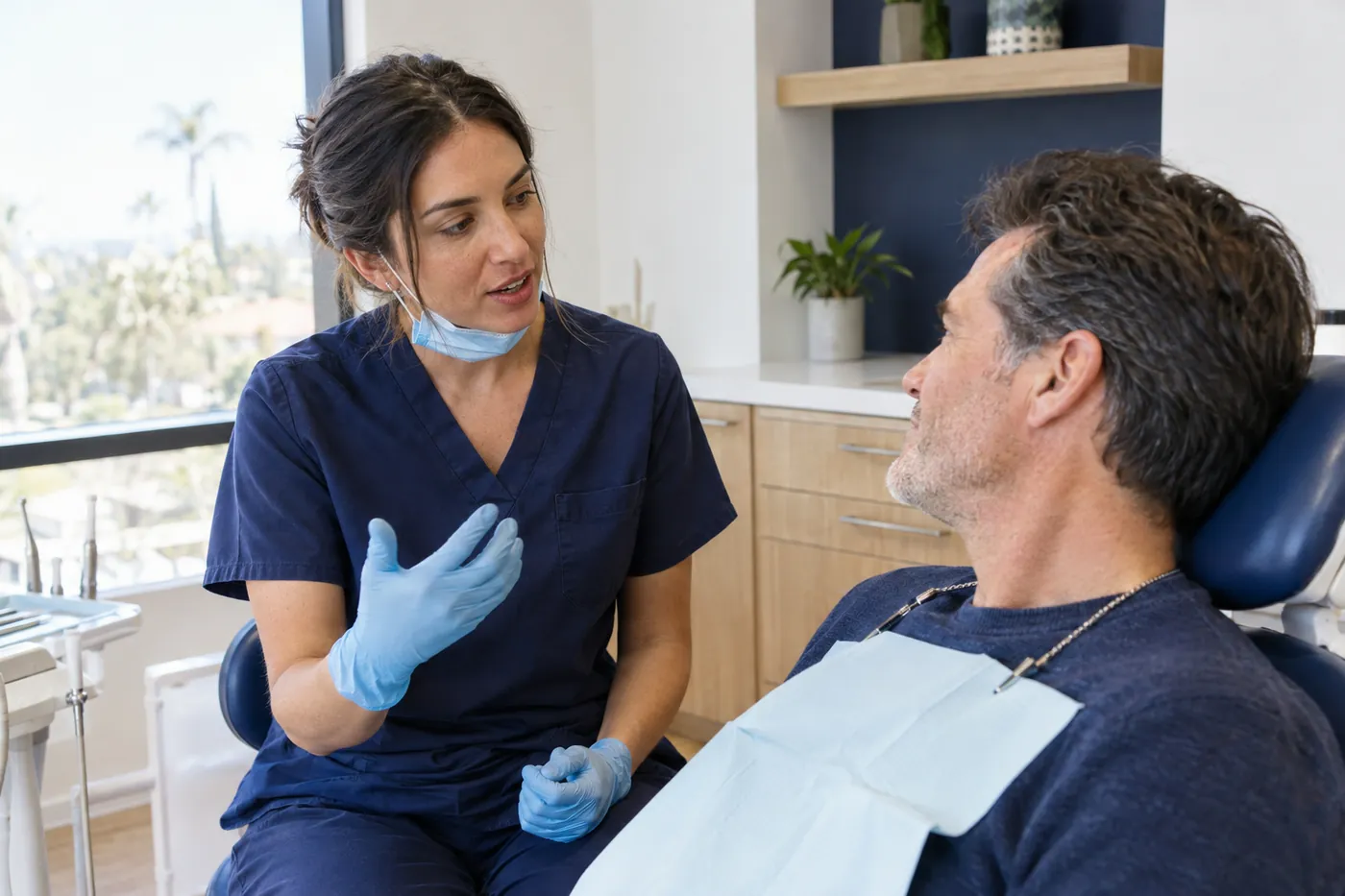
At a glance
Common causes of a loose adult tooth
Most loose teeth trace back to one of these causes, and an exam can show which one applies to you.
- Gum disease
Plaque and tartar inflame the gums, then break down the bone and ligaments that hold a tooth. It is the most common cause in adults.
- Injury to the mouth
A fall or a hit during sports can loosen a tooth or push it out of place, even when nothing looks broken.
- Grinding or clenching
Steady pressure from grinding, often during sleep, can strain the tissues that support a tooth over time.
- Pregnancy
Hormone surges can loosen the tissues around teeth for a while. Tell your dentist if you are pregnant and notice this.
- Smoking and diabetes
Both raise the risk of gum disease, which is the path to most loose teeth in adults.
What can I do at home for a loose tooth?
Home care cannot tighten a loose tooth, but it can lower the chance of problems while you wait to be seen. Cleveland Clinic suggests these steps:
- Rinse with warm salt water to calm the gums.
- Swish with an antibacterial mouth rinse twice a day.
- Skip hard, crunchy and chewy foods for now.
- Keep brushing twice a day with fluoride toothpaste and cleaning between your teeth, as NIDCR advises for healthy gums.
- For soreness, an over-the-counter pain reliever may help. Follow the label, and ask a pharmacist if you take other medicines.
Home care is a bridge, not a fix
These steps will not tighten a loose tooth. Book a dental visit as soon as you notice the looseness.

What should I do if an injury loosens or knocks out a tooth?
Call a dentist right away. The AAE, a national dental association, explains that a dentist can move a pushed or shifted tooth back into place and hold it steady with a splint while it heals.
If an adult tooth is knocked out, hold it by the crown, the part that shows when you smile, not the root. Rinse the root with water without scrubbing, and try to set it back in the socket facing the right way, but never force it.
If you cannot put it back, keep it moist in milk or between your cheek and gum, and get to a dentist quickly. The AAE says treatment within 30 minutes gives a knocked-out tooth the greatest chance of being saved.
Permanent teeth that were pushed out of place often need root canal treatment later, plus follow-up visits to watch the root. Our page on emergency dental care covers what to expect.
Is a loose tooth a dental emergency?
A loose tooth after an injury is urgent, and so is a loose tooth with swelling, pus or a bad taste, since these can be signs of infection. Call a dentist as soon as you notice them.
Some symptoms need emergency medical care right now. Call 911 or go to the nearest emergency room if you have any of the following:
- Swelling in your face, jaw or neck that makes it hard to breathe or swallow
- Swelling that spreads toward your eye or changes your vision
- A fever of 100.4°F or higher with facial swelling
- Bleeding that will not stop with steady pressure
- A serious injury to the face or jaw, such as a possible broken jaw
Breathing comes first
If swelling makes it hard to breathe or swallow, do not wait for a dental office to open. Call 911.
When should I see a dentist about a loose tooth?
See a dentist as soon as you notice a tooth moving, even if it does not hurt. Cleveland Clinic warns that waiting too long can lead to pain, swelling and infection.
When you come in, your dentist will examine the tooth, your gums and your bite to find the cause and plan treatment. If images are needed, our Murrieta office has digital X-rays and 3D imaging, which you can read about on our 3D imaging page.
Treatment depends on the cause. Cleveland Clinic describes options such as a deep cleaning (scaling and root planing), a splint that bonds the loose tooth to its neighbors, a small bite adjustment, or a night guard for grinding. Gum and bone grafts may help in some cases.
If a tooth cannot be saved, it can be removed and replaced with a dental bridge or a dental implant. Implants are placed in our office, from start to finish.
When gum disease is behind the looseness, our gum disease treatment page explains how care works. To be seen, call (951) 677-1054 or request an appointment.

How can I keep my teeth from getting loose?
Healthy gums are the main defense. NIDCR recommends brushing twice a day with fluoride toothpaste, cleaning between your teeth every day, and getting regular checkups and professional cleanings.
A few habits make a real difference:
- Do not smoke or vape. NIDCR calls smoking the most significant risk factor for gum disease, and quitting can improve treatment results.
- Wear a night guard if you grind your teeth, and a mouth guard for contact sports.
- Get enough calcium and vitamin D.
- If you have diabetes, tell your dentist, since it raises the risk of gum disease.
- Treat bleeding gums early. Gingivitis can often be reversed with a professional cleaning plus daily brushing and flossing.

Getting a checkup if it has been a while
If it has been some time since your last visit, our cleanings and exams page explains what a checkup covers. We work with most dental insurance plans, including most PPOs, and you can learn more on our dental insurance page.
Many dental benefits renew at the end of the year, and our team is happy to help you use yours before then.
Questions & answers
Common questions
Will a loose tooth eventually tighten back up?
Sometimes. Cleveland Clinic says some loose teeth firm up after nonsurgical care, such as a professional cleaning and better brushing and flossing at home. Others need gum treatment, bone or gum grafts, or a splint, and some cannot be saved. An exam is the only way to know which group your tooth falls into.
Will a wobbly adult tooth eventually fall out?
It can. When gum disease keeps breaking down the bone and ligaments around a tooth, the tooth can loosen further and may be lost. MedlinePlus notes that periodontitis is the primary cause of tooth loss in adults. Treatment aims to stop that process, and if a tooth does need to come out, a bridge or implant can fill the space.
How long can you go with a loose tooth?
There is no safe waiting period to count on. Cleveland Clinic advises booking a dental visit as soon as you notice a loose tooth, because waiting can lead to pain, swelling and infection. If the tooth loosened after an injury, call a dentist right away, since injured teeth do better when they are steadied quickly.
How does a dentist treat periodontal disease?
Early gum disease can often be reversed with a professional cleaning and daily brushing and flossing. More advanced disease usually needs scaling and root planing, a deep cleaning below the gumline. NIDCR notes that some people also need a medicated rinse or surgery. MedlinePlus adds that people with periodontitis often need cleanings about every three months.
What gum disease is worse than gingivitis?
Periodontitis. Gingivitis is the early stage, when gums are red, swollen and may bleed, and it can usually be reversed. If it is not treated, it can become periodontitis, an infection of the ligaments and bone that support the teeth. That is the stage when teeth can loosen, shift or be lost.
Can pregnancy make your teeth feel loose?
It can. Cleveland Clinic explains that hormone surges during pregnancy can loosen the tissues that hold teeth in place for a while. The American Dental Association also lists pregnancy as a risk factor for gum disease. Tell your dentist you are pregnant, keep up with brushing and flossing, and have any loose tooth checked rather than assuming it will pass.
Keep reading
Related care and answers
Gum Disease Treatment
Bleeding or swollen gums? Learn the signs of gingivitis and periodontitis, how a deep cleaning works, and how
Emergency Dental Care
What counts as a dental emergency, what to do now for a knocked-out or broken tooth, toothache or swelling, an
Bleeding Gums
Why gums bleed when you brush or floss, what helps at home, when bleeding is an emergency, and how a dentist t
Swollen Gums
What causes swollen gums, safe ways to calm them at home, when swelling is an emergency, and when to see a den

Missing Teeth
Why adults lose teeth, what happens when a gap is left alone, and how implants, bridges and dentures compare.

Dental Symptoms Guide
Find your dental symptom, learn what it may mean and what helps at home, and know when to call 911, go to the
Sources
- Loose Tooth: Causes & What To Do · Cleveland Clinic
- Periodontal (Gum) Disease · National Institute of Dental and Craniofacial Research
- Periodontitis · MedlinePlus (National Library of Medicine)
- Gum Disease · American Dental Association, MouthHealthy
- Gum Disease Information · American Academy of Periodontology
- Traumatic Dental Injuries · American Association of Endodontists
- What Is a Dental Emergency and Where To Go for Care · Cleveland Clinic
- Tooth Abscess: Symptoms, Causes & Treatment · Cleveland Clinic
- Ludwig’s Angina: Symptoms, Signs & Treatment · Cleveland Clinic
- Orbital Cellulitis: Causes, Symptoms & Treatment · Cleveland Clinic
Golden Triangle Dentistry is not affiliated with these organizations. Links open in a new tab.
Important information: This page is general information, not a diagnosis. Only a dental exam can show why a tooth is loose, so please see a dentist about your symptoms.
Golden Triangle Dentistry
Book a visit
25460 Medical Center Dr, Suite 202, Murrieta
Worried about a loose tooth?
Call (951) 677-1054 and our Murrieta team will help you set up a visit to have it checked.